
Created by: Yuxuan Song, Ziyi Hao, Rosie Busby-Bell
Overview: This project examines how generative AI interprets and reconstructs Chinese visual culture. Working with text-to-image models, the artists set traditional ink painting—with its emphasis on emptiness and negative space—against the systems’ tendency to fill every part of the frame. From this tension emerged a visual direction the group calls Cyber Jianghu: a fusion of classical Chinese architecture with cyberpunk elements of dark light, metallic surfaces, neon reflection, and mechanical structure. The resulting video traces an evolution across three stages, from traditional ink aesthetics, through Cyber Jianghu, to vast mechanical landscapes. The work treats AI not only as a creative tool but as an object of critical inquiry. In generating these images, the group found the models reaching consistently for a modern, commercial visual language rather than the logic of traditional ink art—filling in negative space, reducing the Chinese dragon to a rigid or monstrous form, yet rendering mechanical architecture with ease. What surfaces is a portrait of the machine’s own cultural defaults: the project reads these limits as structural rather than accidental.
Created with: Midjourney, Jimeng
Concept
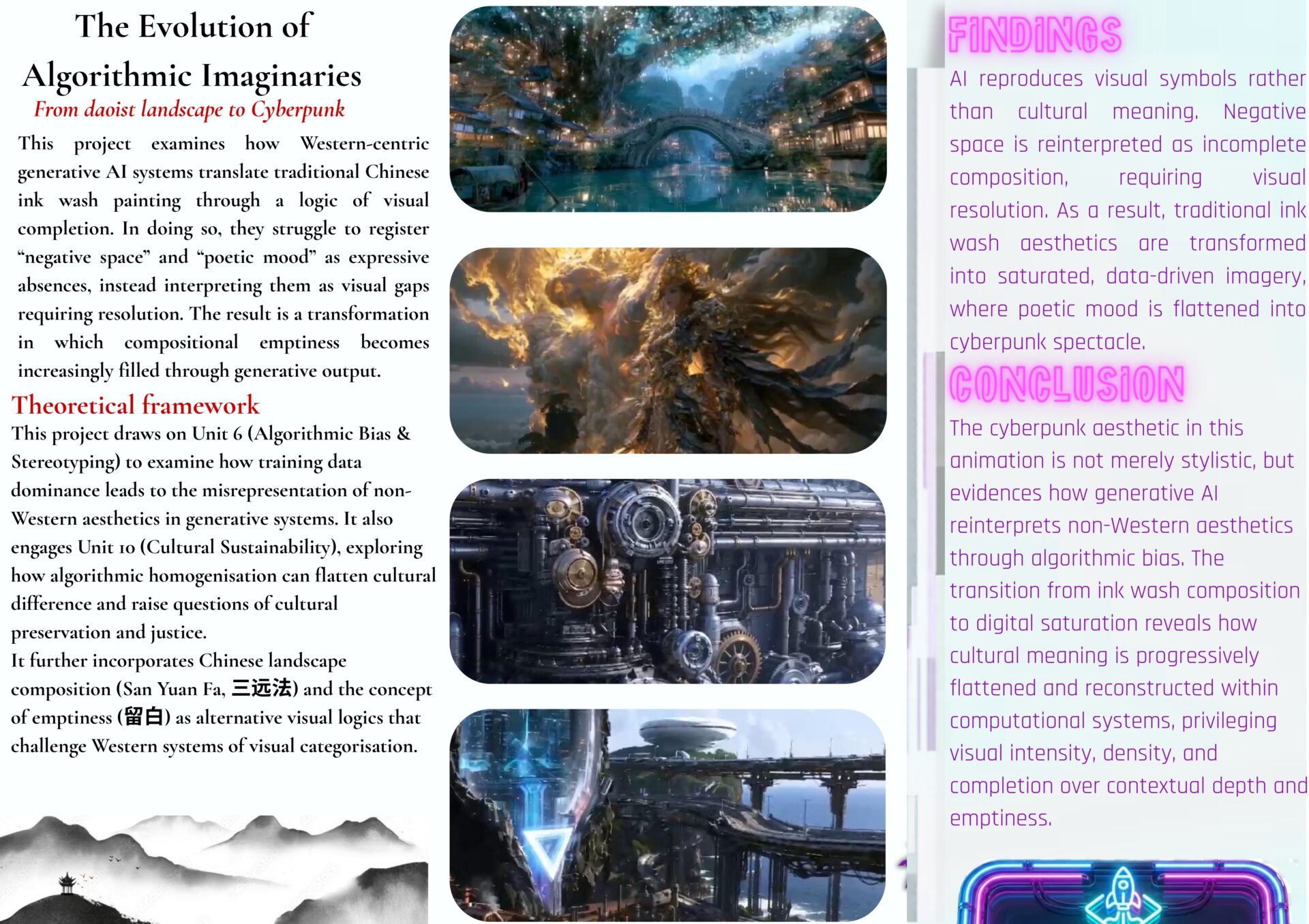
Poster description: The poster shows a visual progression from soft ink wash landscapes at the bottom left to dense, saturated cyberpunk cityscapes and neon-lit mechanical environments across the centre and right, illustrating how generative AI transforms traditional Chinese aesthetics through a logic of visual completion. It argues that AI reproduces visual symbols rather than cultural meaning, reinterpreting negative space as incomplete composition and flattening ink wash traditions into data-driven spectacle that privileges intensity, density and completion over contextual depth and emptiness.